
A cash-flow model for Probably Stolen: margin per turn, rent cover, the best midgame lanes, and when to reinvest instead of expand.
Probably Stolen How to Make Money: Mid-Game Cash Guide
Midgame money is not one big sale. It is margin per transaction × transactions per day × days the lane stays open, minus rent and risk. Pick the lane with the highest repeatable daily margin you can actually supply, keep two rent cycles in cash, and reinvest only in the step that is currently limiting your throughput.
Most "how to make money" advice for Probably Stolen lists a product and a price. That is not enough in a game with events, faction multipliers and inspections. A 300-credit sale is worth less than three 120-credit sales if the big sale brings Security to your door. This guide gives you the model, then the lane comparisons.
The only formula you need
Daily operating profit = (average sale − cost of goods − fees) × sales per day − daily overhead.
Then subtract risk:
Risk-adjusted profit = daily operating profit × (1 − expected loss rate).
Expected loss rate is the share of daily profit you expect to lose to seizures, fines, bribes, spoiled stock or missed customers. A fence run with a 20% loss rate is worse than a water run with a 2% loss rate, even if the fence ticket is larger.
For a machine, use payback:
Payback days = machine price ÷ extra daily profit.
If payback is longer than the time until your next rent increase, the machine is an expansion, not a fix.
What "midgame" means here
Early game is about covering rent. Midgame starts when you have all three:
- Rent covered before the due day, with a buffer.
- One supplier or machine that produces stock without scavenging.
- One faction contact who buys a category at a better price.
At that point, the constraint moves from "find a customer" to "increase throughput without increasing risk". There are four ways to do that: raise margin per item, sell more items per day, reduce cost of goods, or reduce losses. Most players only try the second one.
Lane comparison
The numbers below are qualitative because prices scale with difficulty and events. The assumptions are stated so you can replace them with your own ledger.
| Lane | Capital needed | Margin per sale | Sales per day | Main risk | Best for |
|---|---|---|---|---|---|
| Appraisal service | Low | Fee-based, no stock | Medium | Misjudging a fake | Adding profit to any lane |
| Water | Low–medium | Thin to medium | High | Liability, bad labels | First repeatable loop |
| Wine | Medium | Medium–high | Low–medium | Aging time, spoilage | Slow, high-value shelves |
| Chemistry | Medium–high | High | Medium | Inspections, purity | Players who like process |
| Guns | High | High | Low | Licence, parts, inspections | High-ticket runs |
| Fencing | Low | High | Medium | Raids, case value | Fast cash, high risk |
| Hydroponics | Medium | Medium | Medium | Seed/water cost, harvest time | Passive-ish supply |
| Rat ranching | Low | Low–medium | High | Disease, overcrowding | Cheap meat and gene sales |
Appraisal is the best second income
Appraisal does not need a machine, a supplier or a shelf slot. It needs a board, a customer and a correct call. The margin is the fee plus the difference between the offered price and the real value. It also compounds: every perfect appraisal moves the An Eye for Value achievement and teaches you the price bands for every other lane.
The mistake is treating appraisal as a free action. A wrong call can cost you the item's value, and a fake sold as real can become a case. Use the appraisal profit guide for the checklist.
Water: the volume lane
The demo-era formula was 1 credit per 25 ml before grade modifiers, which means 1 litre is roughly 40 credits at base grade. A 6-litre container is roughly 240 credits before the grade multiplier. If High grade adds 50%, the same container is roughly 360 credits. These are demo-era reference numbers and need testing in 1.0.0.6; the grade thresholds and the filter behaviour changed in 1.0.
The real margin depends on three things: what you paid for source water, how much filter durability the batch consumes, and whether the customer tests. If you collect free source water and sell to buyers who do not test, the margin is high. If you buy source water and sell to lower-level buyers with test strips, the margin is thinner but safer.
Wine: the patience lane
Wine is a margin-per-bottle business, not a volume business. The inputs are grapes or fruit, the machine time, and the aging time. The output price depends on grade and customer. The winemaking guide covers the process; the money point is that wine ties up capital while it ages. Do not start a wine batch with money you need for rent.
Chemistry: the margin ceiling
Chemistry has the highest ceiling and the highest variance. A pure batch sold to the right buyer is excellent. The same batch sold to the wrong buyer, or handed to the cartel below the requested purity, is a loss or an ending. The chemistry profit guide explains how to price purity and why "Lab Pure" is both an achievement and a warning label.
Guns: the ticket-size lane
Guns are high ticket, low volume and paperwork-heavy. The licence, the parts and the inspection risk all sit between you and the margin. A gun sale can cover a rent payment; it can also bring a case worth more than the gun. Only enter after you have a Security plan and a parts supplier.
Fencing: the velocity lane
Fencing is the fastest way to turn a found item into cash. It is also the fastest way to meet a raid. The margin comes from buying low from people who cannot sell legally and selling to customers who do not ask questions. The fence guide covers hiding spots, bribes and raid recovery.
A simple weekly allocation
Once rent is covered, split new money like this:
- 50% into the working lane. More stock, more supplies, one throughput upgrade.
- 30% into the next lane or a higher-value customer. This is growth capital; it can wait a week.
- 20% into the rent reserve. Never invest the reserve, even if a supplier offers a "once per run" deal.
If the reserve is already two rent cycles, move the 20% into growth. If it is below one cycle, stop all growth spending.
When to reinvest, and when not to
Reinvest when the bottleneck is obvious:
- Customers are waiting and you have no stock → buy stock.
- Stock is ready and you have no customers → improve display, appraisal board or signage.
- Customers want a grade you cannot produce → buy the machine or the filter.
- You are manually processing one batch at a time and losing sales → buy the second machine.
- You are losing money to seizures → spend on hiding, labels or bribes, not on more contraband.
Do not reinvest when:
- The purchase leaves you below one rent cycle.
- The machine's payback is longer than the time to the next rent increase.
- The new lane needs a skill or faction you do not have.
- You are buying because the item is discounted, not because a customer asked.
The midgame trap: expanding into a second identity
A water merchant who buys a gun licence is no longer a water merchant. They are a water merchant with a second supply chain, a second set of inspections and a second reputation risk. That can work, but it should be a deliberate second act, not an impulse purchase.
The safer progression is one lane plus appraisal, then one lane plus a processing step, then a second lane that shares customers. Water and hydroponics share water infrastructure. Wine and hydroponics share fruit. Guns and fencing share the black market. Chemistry and the cartel share a storyline but not a customer base.
Daily checklist
- Read the ledger: rent due, cash, stock value.
- Check the shutter events: price modifiers change what is worth selling today.
- Appraise the highest-value item on the counter before you quote.
- Sell the slow stock before buying new stock.
- Record the day's margin by lane. After three days, cut the worst lane.
- Move profit to the reserve before you shop.
The rent and buyout guide turns this into a closing plan. If you are already profitable but cannot finish, the problem is usually the buyout timing, not the margin.
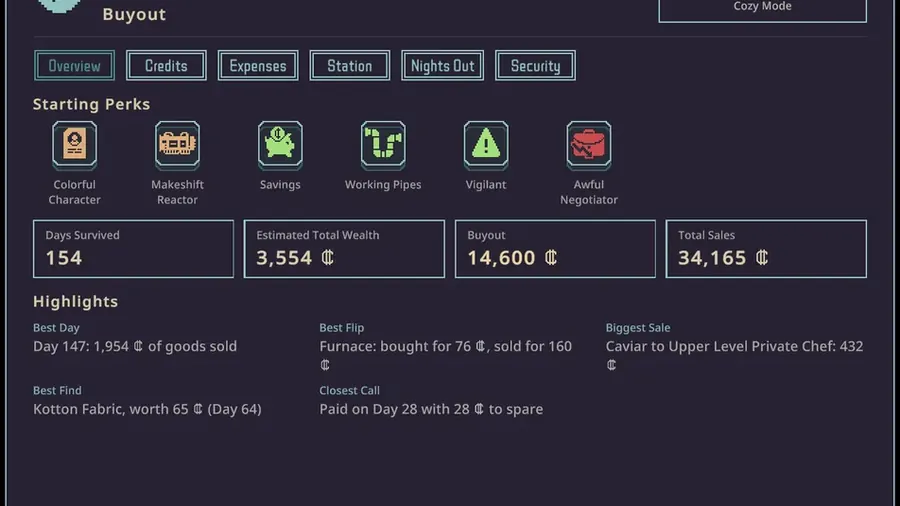
The AquaFarmer ledger records volume and price; the same cash discipline applies to every route.
FAQ
What is the fastest mid-game cash route?
Water trading has the lowest input cost. Chemistry and guns have higher tickets but need more capital and carry more risk.
Do I need contraband to reach a buyout?
No. Legal routes reach the buyout; contraband accelerates cash at the cost of Security and raid risk.
How much should I reinvest?
Keep one rent cycle in reserve and reinvest 40–60% of profit into stock or machines.
Sources and assumptions
- Steam store page and 1.0.0.6 patch notes.
- In-game ledger, appraisal board and grade labels, checked 2 November 2026.
- Water formula is the demo-era 25 ml = 1 credit reference and is explicitly marked needs testing for 1.0.0.6.
- Machine prices: Water Filter 25 (1.0.0.2), Water Purifier 250 (1.0.0.5), Moisture Farm 350 (1.0.0.2).
Official source: Steam store ↗ · Steam guides ↗ · Steam Workshop ↗, checked 2 November 2026.
More Probably Stolen Guides
All the starting perks that matter, ranked for money, crime, water and challenge runs, with exact point costs and the best three-point loadouts.
All nine Probably Stolen starts compared by credits, rent, gear and risk, with the best pick for a first run, a profit run and Rock Bottom.
How Brewing Expansion works: the 16 seeds, 67 wine recipes, growing and aging loop, automation, profit assumptions and compatibility with vanilla winemaking.
A profit-first Probably Stolen chemistry guide: purity math, acid and base workflow, contaminant control, and which chemicals are worth the risk.
Case value, investigation, raids, fines and bribes in Probably Stolen: how the crime system builds a case and how to stop it before 1,500 credits.
Which Probably Stolen mods actually change profit, which only save clicks, and how Brewing Expansion, WaterTower, Proficiency and CorpPresence affect a run.
The five Probably Stolen factions, what reputation unlocks, which choices raise or lower it, and the -100 thresholds that end runs.
How to fence stolen goods, hide contraband, handle raids and bribe Security in Probably Stolen without ending the run.