
Hydroponic farming, Nutrifruit, fish and organ dealing in Probably Stolen: setup costs, harvest math, and the risks of the biological trade.
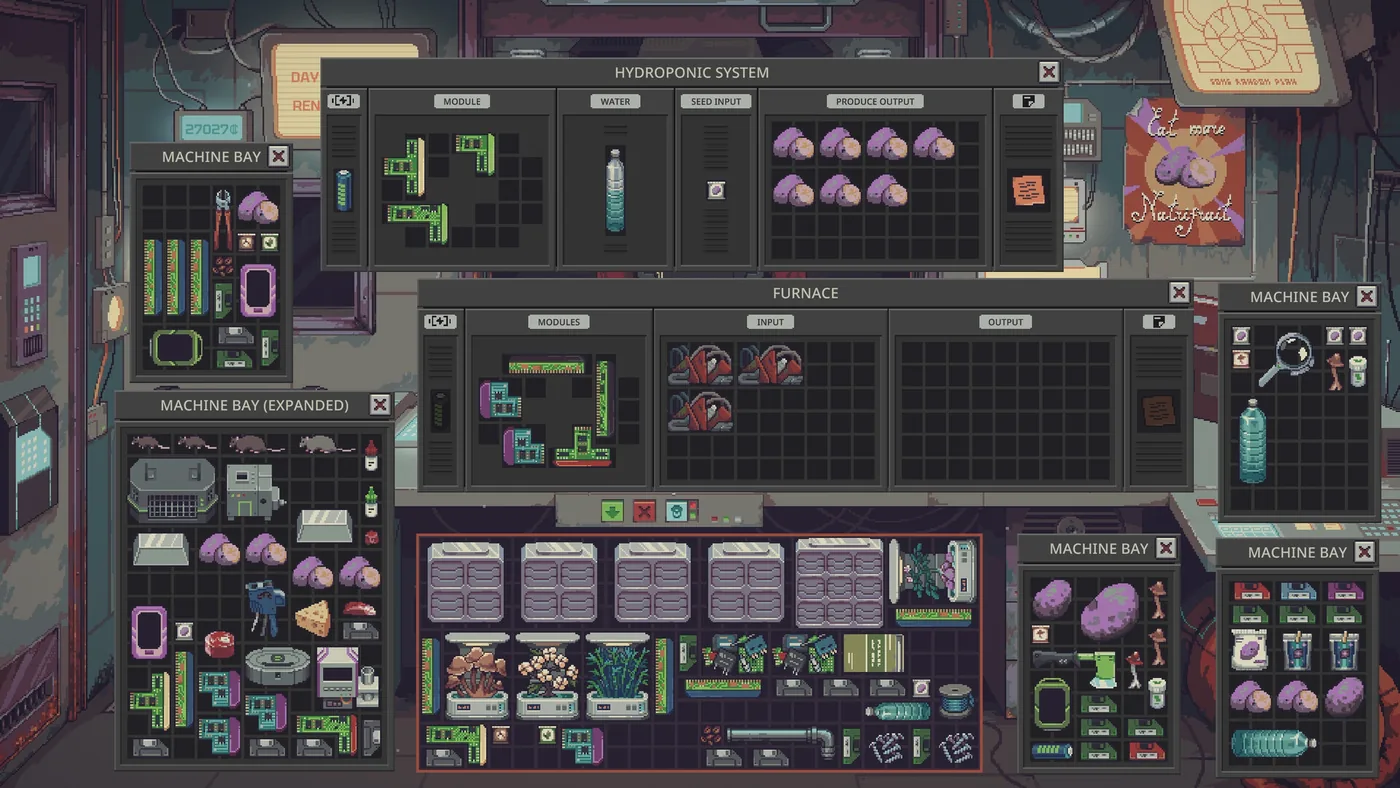
Probably Stolen Hydroponics Guide: Farm and Organ Route
Hydroponics is a supply lane: seeds and water become fruit, and fruit becomes wine, food or a counter sale. Organ dealing is a separate, higher-risk lane that shares the biological theme but not the customer base. Start with plants, learn the harvest cycle, and only add organs when you have storage and a faction buyer.
The Hydroponic Farmer and Aquafarmer starts are the game's "grow it yourself" routes. They are slower than fencing and less glamorous than chemistry, but they produce stock you can sell without scavenging. The organ dealer is the dark mirror of the same idea: instead of growing a product, you move a body part.
This page covers both because the game groups them under the biological trades, but they are not the same business. Plants are a production chain; organs are a sourcing and storage problem.
The hydroponic setup
The entry machine is the Moisture Farm, 350 credits after 1.0.0.2 (it was 650 at launch). It provides the water and the growing environment for a small farm. The Water Filter at 25 credits is the cheap support machine; the Water Purifier at 250 credits is the upgrade if your source water is poor.
A minimal farm needs:
- One Moisture Farm.
- A clean water source and a filter.
- Seeds for one crop.
- A light or the farm's built-in lighting.
- A shelf or counter slot for the harvest.
The farm does not need a separate room at the start. It needs a reliable water supply and a crop that sells.
The harvest math
Crop profit = (harvest yield × sale price) − seed cost − water cost − machine time − loss rate.
The variables are:
- Yield. How many units the crop produces per cycle. A high-yield crop with a low price can beat a low-yield premium crop.
- Cycle time. The days from planting to harvest. A fast crop with a thin margin can be better than a slow crop with a fat one.
- Water cost. The Moisture Farm consumes water; if you are buying it, the cost is real.
- Loss rate. Disease, contamination, pests or a bad batch. Hydroponics is more controllable than outdoor farming, but not risk-free.
The Green Thumb achievement requires growing a Huge Nutrifruit. That is a quality target, not a profit target. Grow Nutrifruit for the achievement and for food sales; grow the profitable crop for the ledger.
What to grow
The game's crop list is in the in-game manual; the community guide "Winemaking and You" covers fruit for wine. The practical categories are:
| Crop type | Use | Margin | Notes |
|---|---|---|---|
| Nutrifruit | Food, achievement, general sale | Low–medium | Huge variant for Green Thumb |
| Wine fruit | Winemaking | Medium–high | Needs a fermenter and aging time |
| High-value produce | Upper-level customers | High | Slower cycle, more attention |
| Feed crops | Rats, livestock | Low | Vertical integration, not a counter product |
Do not grow a crop you cannot sell. A harvest that sits in the back room is a water bill with leaves.
Fish and the Aquafarmer
The Aquafarmer start is the aquatic version of the same loop. Fish are a protein product with a customer base and a tank requirement. The economics are similar: feed cost, water quality, growth time, sale price. The advantage is that fish can be sold to food buyers and used in recipes; the disadvantage is that the tank is another machine with another failure mode.
If you are choosing between the two, pick the one whose product your existing customers already ask for. A hydroponic farm next to a wine shelf is a supply chain; a fish tank next to a water counter is a second biology project.
Organ dealing: the other biological trade
The organ dealer lane is not farming. You are not growing the product; you are acquiring it, storing it and selling it to a buyer who needs it. That makes it a sourcing business with a short shelf life and a high legal risk.
What you need:
- A supplier. The organ trade has a supply chain; you do not produce the organs yourself.
- Storage. Organs are perishable and incriminating. A normal shelf is not enough.
- A buyer. Medical customers, black-market buyers and factions pay differently.
- A legal cover. A clinic, a medical licence or a legitimate front reduces suspicion. It does not make the trade legal.
The profit can be high because the product is scarce and the buyer is motivated. The risk is also high: a single organ can be worth more than a gun case, and the wrong buyer can report you.
Wine improves with time. Organs decay. If you hold an organ for a better price, you may lose the product and the capital. Sell to the first buyer who meets your reserve, not the highest price you can imagine.
Combining the lanes
The biological lanes combine well with:
- Water. Clean water is an input for plants, fish and organ storage; the water merchant route covers the grades.
- Wine. Fruit from the farm feeds the fermenter; see the winemaking profit guide.
- Rats. Feed crops and meat share the biological supply chain, but the disease risk is separate; the rat ranching guide covers the cage.
- Appraisal. A mispriced organ or a fake medical certificate is a double loss; use the appraisal profit guide.
They combine badly with:
- Guns. The customer base and the inspection profile are different.
- Fencing at full volume. The case values add up.
- A low cash reserve. Plants and organs both tie up capital.
A first-week farm plan
- Buy the Moisture Farm only after the rent is covered.
- Plant one fast crop, not four experimental ones.
- Test the water before the first harvest.
- Sell the harvest to the customer type that already visits.
- Record yield, water used and sale price.
- Add a second crop only if the first clears its costs twice.
For the organ lane, wait until week two or later. You need storage, a buyer and a reserve before the first purchase.
Organ storage on the shop floor. Cold inventory is capital with a decay timer.
FAQ
Should I farm or deal organs?
Hydroponics is steadier and legal. Organs are higher-ticket but attract Security and faction attention.
How many grow beds do I need?
Two systems cover early demand. Add a third only when you can staff and water it.
Are organs legal?
Some are. Check the buyer and the item's contraband flag before displaying them.
Sources and version notes
- Steam store page and in-game farm/organ UI, checked 2 November 2026.
- Moisture Farm price 350 after 1.0.0.2; Water Filter 25; Water Purifier 250 after 1.0.0.5.
- Achievement "Green Thumb" and start list cross-checked against the community achievement table.
- Build 1.0.0.6.
Official source: Steam store ↗ · Steam guides ↗ · Steam Workshop ↗, checked 2 November 2026.
More Probably Stolen Guides
Licences, permits, weapon mods, inspections and margins for the Probably Stolen gunsmith route, with a practical risk plan.
How to make a Probably Stolen mod: the official C# API, manifest.xml, build setup, hook points, dev console and Workshop publishing.
How the Rat Wrangler start works: cage setup, feeding, breeding, genes, disease control and the math that decides whether rats are profitable.
Water grades, testing, filters and profit math for the Probably Stolen water merchant route, including what changed in 1.0 and what still needs testing.
How winemaking works in Probably Stolen: fruit, fermentation, aging, bottle value, and the profit math behind a wine shelf.
All 17 Probably Stolen endings, the exact triggers for each, how to reach the two buyout wins and how to avoid the reputation-floor losses.
The best Probably Stolen mods by play style, with Workshop IDs, subscription counts and compatibility notes for the 1.0.0.6 modding update.
How Brewing Expansion works: the 16 seeds, 67 wine recipes, growing and aging loop, automation, profit assumptions and compatibility with vanilla winemaking.