
How to price items, read authenticity, use appraisal slips and avoid the expensive mistakes that turn a perfect appraisal into a criminal case.
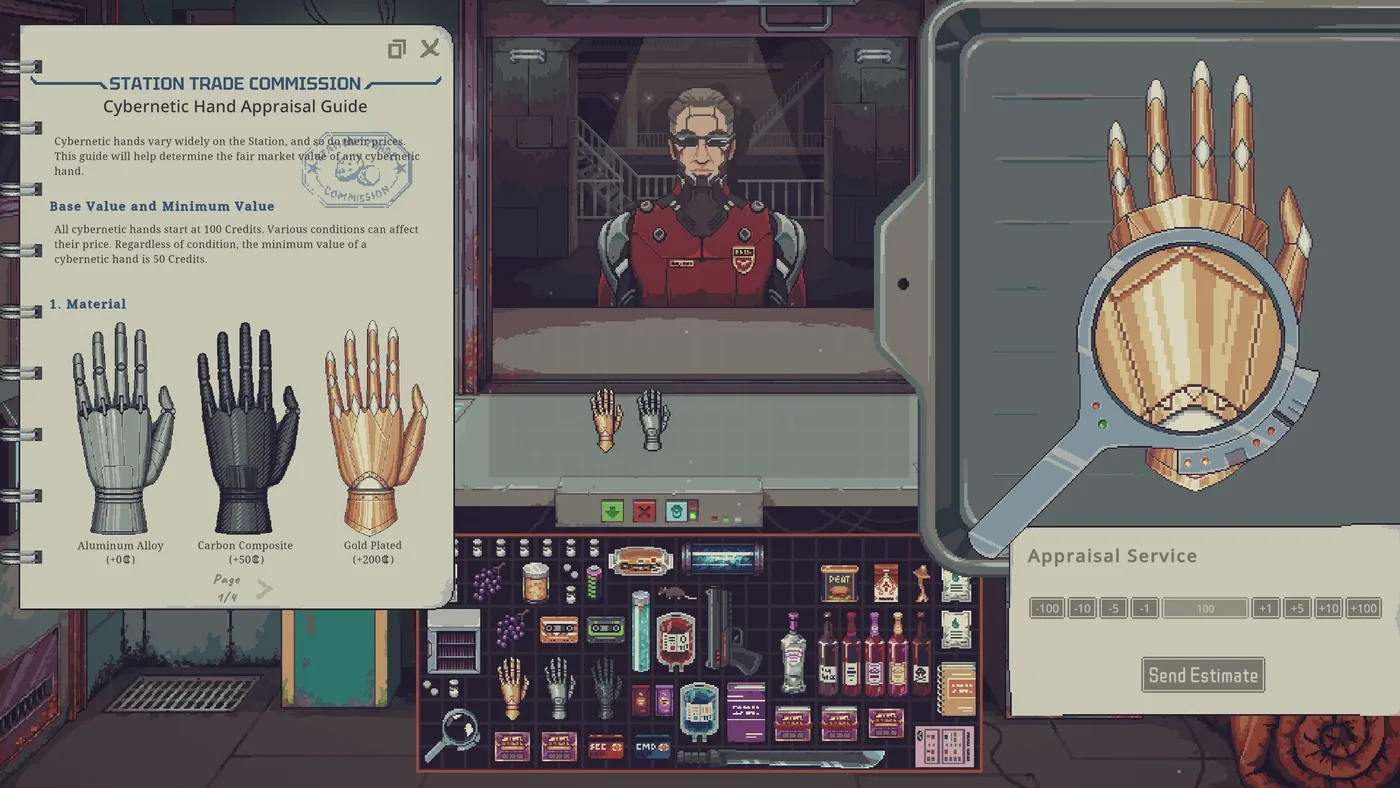
Probably Stolen Appraisal Guide: Profit and Perfect Slips
Appraisal is the safest profit in Probably Stolen because it needs no machine and no stock. Read the item, check authenticity before value, and quote from the real value, not the customer's story. Ten perfect appraisals unlock An Eye for Value; one bad fake sold as real can cost more than the fee.
Every customer brings a claim. The glove is pre-war. The watch belonged to an executive. The injector is genuine Immunivax. The food stamp is real. Your job is not to believe the claim; it is to price the object behind it.
Appraisal is a service and a discipline. The service pays a fee; the discipline protects every other lane. A water merchant who cannot spot a fake label is a water merchant with a case file.
The four-layer appraisal
Use the same order every time. Changing the order is how you miss the fake.
1. Identify the item
What is it, and what category does it belong to? The category determines the price band and the tests that apply.
- Injectables and medicine. Immunivax, Nomore Injectors, counterfeit doses. Authenticity is the whole value.
- Food stamps and documents. Paper, print quality, serial, issuer. A fake stamp is a crime.
- Cigarettes and consumables. Packaging, seal, tax mark. The game expects a visual inspection.
- Rare goods and collectibles. Provenance, condition, matching parts.
- Water and chemicals. Grade and purity, not brand.
- Weapons. Serial, licence, mod configuration.
2. Check authenticity before value
A genuine item at 80% condition can be worth more than a fake at 100%. Value without authenticity is a number attached to a lie.
Use the appraisal board, the magnifier or the item tooltip. If the UI gives you a red/green flag, read the reason, not just the colour. A red flag on a cigarette pack can mean a broken seal, a missing tax mark or a counterfeit print; each has a different price implication.
3. Establish the real value
The real value is built from:
- Base value. The item's reference price.
- Condition. Wear, damage, missing parts.
- Authenticity. Genuine, repaired, counterfeit, stolen.
- Combination bonus. Sets, matching parts, complete kits.
- Demand. The current customer and the current event.
The appraisal board shows a range. The customer's offer is a negotiation, not the value. Your profit is the gap between the real value and the price you pay or the fee you charge.
4. Price the risk
A genuine item with a stolen serial is not the same as a genuine item with clean provenance. A fake that the customer will never test is not the same as a fake sold to a Security inspector. Add a risk discount:
Risk-adjusted value = real value × (1 − probability of seizure or refund).
If the item is stolen, the probability is not zero. If the buyer is Security, it is higher. If the item is a counterfeit injectable, the downside is not a refund; it is a case.
The appraisal slip
The appraisal slip is the paper trail. It records the item and the price, and it can bring customers to the board. Keep the slips organised; a stack of unresolved slips is a stack of unfinished business.
The Appraisal Slip to Trash mod (Workshop 3829353625) automatically discards slips after they are processed. It is a QoL fix, not a gameplay change; the QoL mods page covers it.
The appraisal board
The board is the best customer acquisition tool in the store. It costs space and attention, but it brings people who want a valuation, not a bargain. That is a different conversation and usually a better margin.
Use the board when:
- Traffic is low and you need customers.
- You have a high-value item you cannot price confidently.
- You want to build reputation with a faction that values fair dealing.
- You are chasing the An Eye for Value achievement.
Do not use the board when:
- You are already at capacity and cannot serve the queue.
- The item is contraband; the board creates a record.
- You are trying to move a fake as real; the board is the last place you want a second opinion.
The ten-perfect-appraisal run
An Eye for Value requires 10 perfect appraisals. A perfect appraisal is not "the customer accepted"; it is the game's own accuracy check. The reliable way to get ten:
- Pick a category you can identify consistently (start with water or cigarettes).
- Appraise the same category ten times, not ten different categories.
- Use the board and the magnifier; do not guess from the customer's description.
- Record the real value and the accepted price.
- If the game flags a mistake, stop and re-read the item's condition and authenticity.
The achievement is a teaching tool. By the tenth perfect appraisal you should know the category's price band without the UI.
Common appraisal mistakes
- Valuing the story, not the item. The customer's provenance claim is not evidence.
- Skipping authenticity because the item looks old. Age is a fake's best disguise.
- Overpricing a genuine item. A fair price builds a repeat customer; a greedy price builds a reputation for gouging.
- Underpricing a stolen item. If you buy it cheap and sell it cheap, you took the risk for no margin.
- Ignoring the buyer. The same item is worth more to a collector than to a scavenger.
- Forgetting the case value. A profitable appraisal of contraband can still be a loss after the raid.
Appraisal and the other lanes
- Fencing: appraise before you buy. A stolen item's real value is the ceiling, not the asking price.
- Water: grade is the appraisal. A mislabeled batch is a fake.
- Wine: vintage and provenance are the appraisal. A bottle with no history is a bottle.
- Guns: serial and mods are the appraisal. A legal frame with an illegal part is contraband.
- Chemistry: purity is the appraisal. A Lab Pure claim without a test is a story.
The crime system guide explains what happens when the appraisal is wrong and the item is illegal.
A daily appraisal routine
- Before opening, appraise the three highest-value items on the shelf.
- When a customer offers an item, identify the category first.
- Check authenticity, then condition, then value.
- Quote a range, not a single number.
- Record the sale and the slip.
- At the end of the day, compare the appraised value with the sale price. If the gap is consistently negative, your method is wrong.
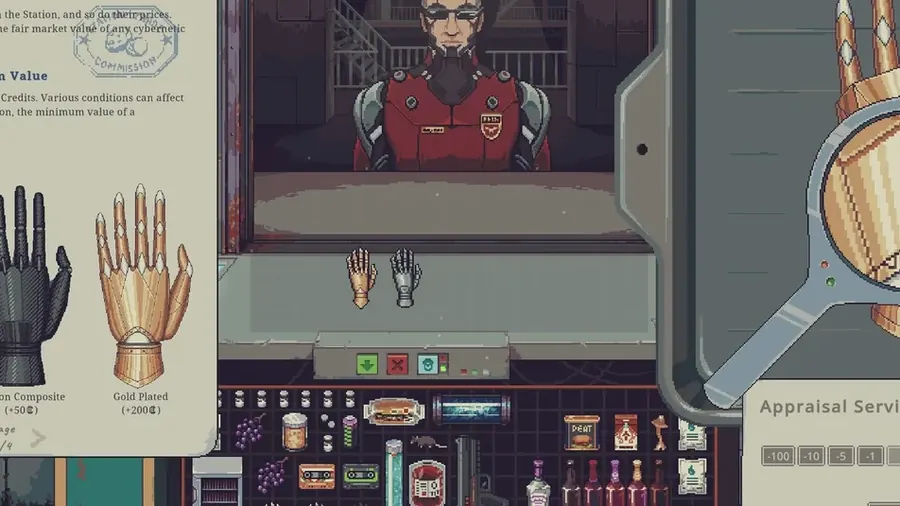
An appraisal slip and a gloved hand: the difference between a guess and a priced item.
FAQ
How do appraisal slips work?
Each slip reveals authenticity and value. Perfect appraisals build the board and count toward the achievement.
What counts as a perfect appraisal?
A correct authenticity call plus a price inside the item's true range.
How do I avoid overpaying?
Use Item Details or the Appraisal Assistant mod, and never bid on a sealed lot without a fallback buyer.
Sources and version notes
- Steam store page and in-game appraisal board/magnifier, checked 2 November 2026.
- Achievement "An Eye for Value" (10 perfect appraisals) cross-checked against the community achievement table.
- Appraisal Slip to Trash Workshop item 3829353625, snapshot 2 November 2026.
- Build 1.0.0.6.
Official source: Steam store ↗ · Steam guides ↗ · Steam Workshop ↗, checked 2 November 2026.
More Probably Stolen Guides
Hydroponic farming, Nutrifruit, fish and organ dealing in Probably Stolen: setup costs, harvest math, and the risks of the biological trade.
How to make a Probably Stolen mod: the official C# API, manifest.xml, build setup, hook points, dev console and Workshop publishing.
How the Rat Wrangler start works: cage setup, feeding, breeding, genes, disease control and the math that decides whether rats are profitable.
Water grades, testing, filters and profit math for the Probably Stolen water merchant route, including what changed in 1.0 and what still needs testing.
How winemaking works in Probably Stolen: fruit, fermentation, aging, bottle value, and the profit math behind a wine shelf.
All 17 Probably Stolen endings, the exact triggers for each, how to reach the two buyout wins and how to avoid the reputation-floor losses.
The best Probably Stolen mods by play style, with Workshop IDs, subscription counts and compatibility notes for the 1.0.0.6 modding update.
How Brewing Expansion works: the 16 seeds, 67 wine recipes, growing and aging loop, automation, profit assumptions and compatibility with vanilla winemaking.