
A profit-first Probably Stolen chemistry guide: purity math, acid and base workflow, contaminant control, and which chemicals are worth the risk.
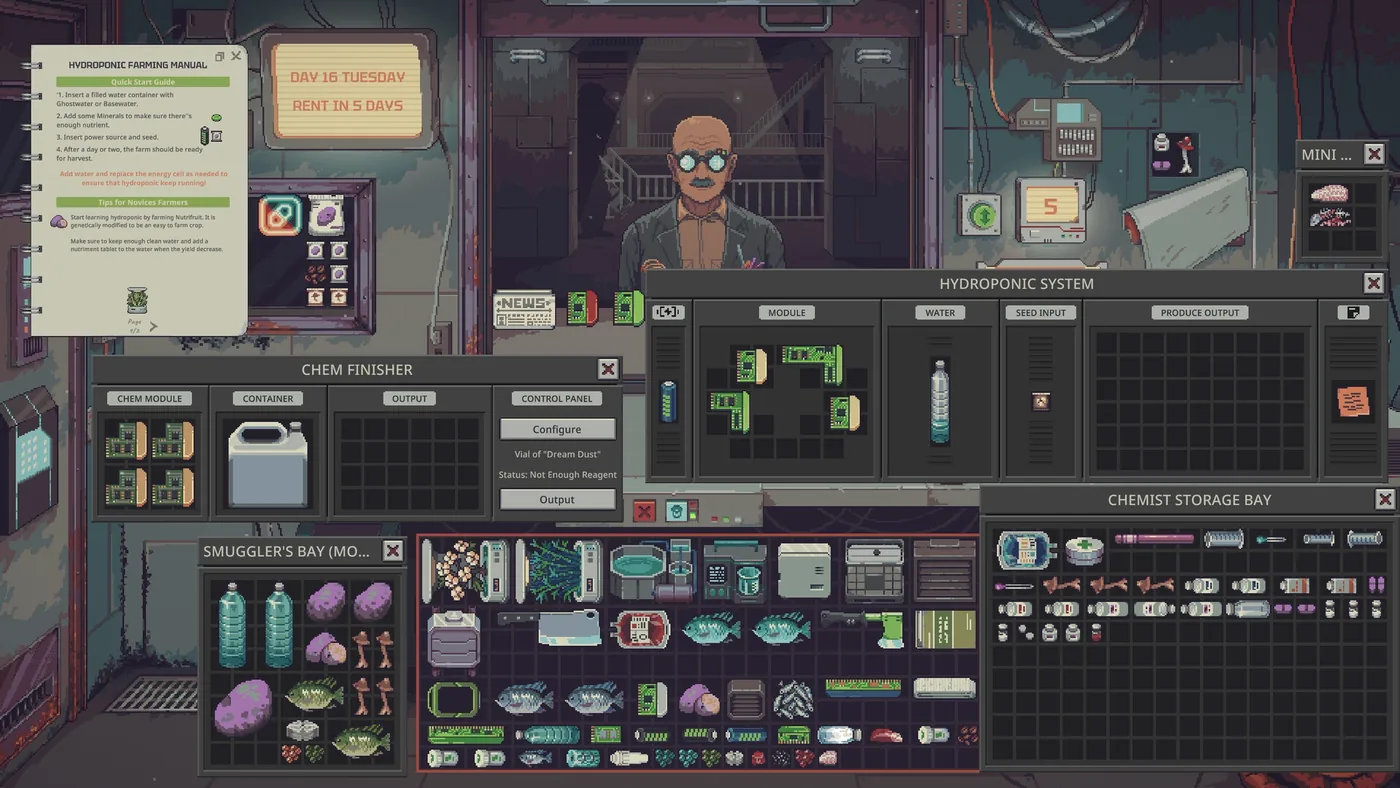
Probably Stolen Chemistry Guide: Recipes, Purity and Profit
Chemistry makes money when you sell purity you can prove, not when you sell volume. Pick one product family, learn its pH window and contaminant sources, keep a clean sample for the cartel handover, and price each batch from its measured purity. If you cannot test it, do not sell it to a faction that can.
Chemistry is the deepest production system in Probably Stolen and the easiest one to lose money in. The in-game manual gives the recipes; this page gives the business around them. It does not reprint the recipe list, because recipes are patched and because the manual is the authoritative source. What it does cover is how to turn a recipe into a repeatable margin without turning your shop into a crime scene.
The four numbers that decide a batch
Every chemistry batch has four values worth recording:
- Input cost. Raw chemicals, containers, water and any catalyst. If you use filtered water, include the filter durability, not just the water price.
- Yield. How many saleable units the batch produces. A recipe that yields one high-purity unit is not better than one that yields four medium units until you multiply by price.
- Purity. The grade the buyer sees. Purity is not a cosmetic; it changes the price multiplier and, for the cartel, whether the handover is accepted.
- Contaminant load. The thing that turns a pure batch into a rejected batch. Contaminants come from dirty equipment, impure water, wrong pH and cross-contamination between runs.
Write these four numbers in a notebook or a spreadsheet. After five batches you will know which product is actually profitable, instead of which one looks profitable in the manual.
Acid and base work is a pH problem
The community guide "How to create high purity acid and base" exists because pH is the part new players skip. Treat pH as a window: the manual gives the target range for the product, and moving outside it increases contaminant load or lowers yield. The practical workflow is:
- Start with the cleanest water you can afford. If your water grade is poor, the batch starts with impurities you cannot remove later. The water guide explains grades and testing.
- Measure before you add. Add acid or base in small steps, not one big pour. The manual's target is a range, not a single number.
- Clean between runs. Residue from the previous product is a contaminant even if it was pure in its own batch.
- Test the finished batch before you bottle it. A batch that tests badly can sometimes be reprocessed; a batch that is bottled and labeled badly is evidence.
A label is a claim. If the bottle says Lab Pure and the tester says otherwise, the customer's result wins. The crime system treats a false label as a case, not a customer complaint.
The product families
The Chemist start gives you a taste of the catalogue: Dream Dust, Nightmare Dust, Phanta, Nomore Injectors and caffeine pills. Each family has a different buyer and a different risk profile.
| Family | Buyer | Margin | Risk |
|---|---|---|---|
| Dream Dust | Cartel, black market | High | Cartel handover purity, raids |
| Nightmare Dust | Black market, addicts | High | Addiction, overdose, Security |
| Phanta | Nightclub/party customers | Medium–high | Adulteration, reputation |
| Nomore Injectors | Medical buyers, scavengers | Medium | Counterfeit medicine, inspections |
| Caffeine pills | General customers | Low–medium | Low risk, low ticket |
| Acids and bases | Other producers, industrial buyers | Medium | pH errors, contaminant load |
The low-risk products are not a waste of time. Caffeine pills and legitimate acid batches build the working capital and the reputation you need before the cartel notices you. The high-risk products are where the margin ceiling is, but they also attract the attention that ends runs.
Purity and the cartel handover
The cartel does not ask for "some Dream Dust". It asks for a purity level. If the average purity of the handover is at or below one quarter of the requested purity, the handover can end in the Retirement failure state. That is not a fine; it is an ending.
The defensive rule is simple: keep one batch that you know meets the request, and do not mix it with a weak batch to make up the quantity. If you are short, buy or produce more; do not dilute. The average is what matters, and one weak batch can drag the average under the line.
The Say My Name achievement requires producing a Lab Pure grade narcotic. Treat that batch as a separate project: clean equipment, clean water, measured pH, and a test before you label it.
Pricing a batch
Use this formula:
Batch profit = (units × price at measured purity) − input cost − machine time cost − risk cost.
Risk cost is the part most players omit. If a batch has a 10% chance of being seized, subtract 10% of the gross. If a batch can trigger a case that costs 500 credits to resolve, subtract that expected cost. A batch that looks like a 200-credit profit can be a 50-credit loss after risk.
Do not price from the highest offer you have ever seen. Price from the repeat buyer who pays on a normal day. Event modifiers and faction multipliers are upside, not baseline.
Chemistry and the crime system
Chemistry is the lane most likely to produce a case. The case value is based on the goods, not on your intent. A shelf of counterfeit medicine can be worth more than a single stolen gun because the game counts the whole stack.
Keep these rules:
- Do not store finished product in the display case. Use a hiding spot or a container that the inspection does not open.
- Do not sell to a customer who announces they are Security. Even if they are lying, the risk is not worth the margin.
- Keep a bribe fund. A small bribe is cheaper than a case that reaches 1,500 credits.
- Do not report your own supplier. It clears one case and closes the supply line.
The fence and contraband guide covers hiding spots and raid recovery; the crime system guide covers case value and investigation.
A five-batch test plan
Before you commit to chemistry as a main lane, run five batches of the same product and record:
- Input cost.
- Yield.
- Measured purity.
- Sale price to the same buyer type.
- Any loss (seizure, rejection, fine).
If the average profit after losses is positive and the variance is tolerable, scale. If the average is positive but one batch in five is a loss, the lane is a gamble, not a business. If the average is negative, change product or change water before you buy another machine.
Chemistry versus the other lanes
- Water is cheaper to start and easier to test. Use it to fund chemistry, not to compete with it.
- Wine is slower but safer; the winemaking guide covers the aging math.
- Fencing is faster cash but a different criminal track. Do not run both at full volume unless you have the hiding space.
- Guns share the inspection risk but not the customer base. A gun buyer is not a Dream Dust buyer.
The money guide compares the daily margin of each lane. Chemistry wins on margin per batch and loses on risk-adjusted consistency.
A lab bench mid-reaction: purity, contaminants and batch size drive the final margin.
FAQ
What is the best beginner recipe?
Start with a single-step stimulant or painkiller you can source reliably. Do not chase Lab Pure on day one.
How does purity affect price?
Higher purity multiplies value; contaminants and wrong pH cut it. The page gives the tested ranges and states its assumptions.
Where do I buy acid and base?
Chemical suppliers and the black market. Prices move, so check the vendor screen before committing to a batch.
Sources and version notes
- Steam store page and 1.0.0.6 hotfix notes.
- In-game chemistry manual and recipe list, checked 2 November 2026. Recipes are not reproduced here.
- Community reference: "The Complete Chemist Guide: Recipes, Purity and Profit" and "How to create high purity acid and base" on Steam Community, used for topic verification only.
- Cartel handover and Lab Pure conditions cross-checked against the ending and achievement lists.
Official source: Steam store ↗ · Steam guides ↗ · Steam Workshop ↗, checked 2 November 2026.
More Probably Stolen Guides
Hydroponic farming, Nutrifruit, fish and organ dealing in Probably Stolen: setup costs, harvest math, and the risks of the biological trade.
How to make a Probably Stolen mod: the official C# API, manifest.xml, build setup, hook points, dev console and Workshop publishing.
How the Rat Wrangler start works: cage setup, feeding, breeding, genes, disease control and the math that decides whether rats are profitable.
Water grades, testing, filters and profit math for the Probably Stolen water merchant route, including what changed in 1.0 and what still needs testing.
How winemaking works in Probably Stolen: fruit, fermentation, aging, bottle value, and the profit math behind a wine shelf.
All 17 Probably Stolen endings, the exact triggers for each, how to reach the two buyout wins and how to avoid the reputation-floor losses.
The best Probably Stolen mods by play style, with Workshop IDs, subscription counts and compatibility notes for the 1.0.0.6 modding update.
How Brewing Expansion works: the 16 seeds, 67 wine recipes, growing and aging loop, automation, profit assumptions and compatibility with vanilla winemaking.